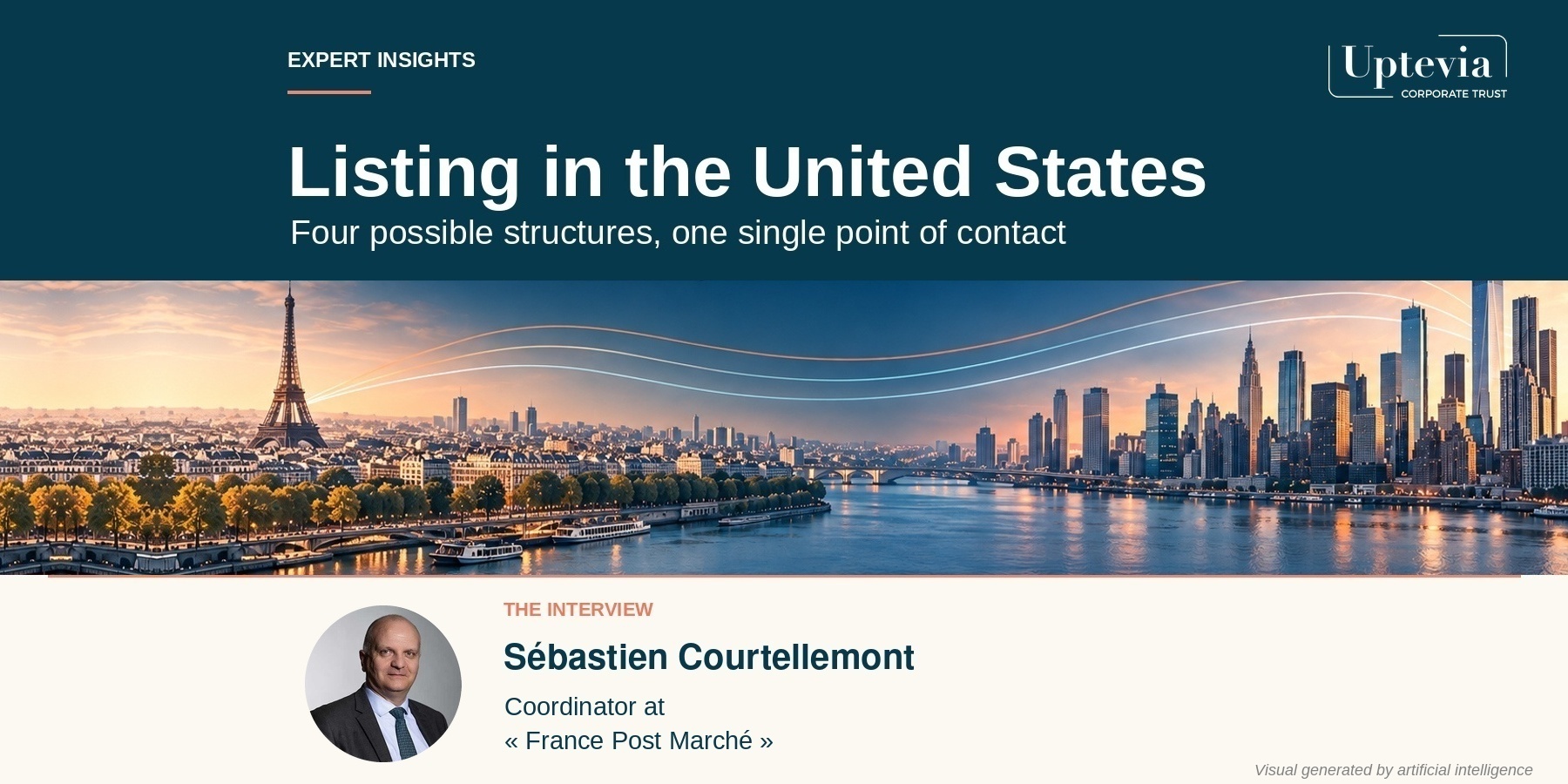
Interview with Sébastien Courtellemont, coordinator at « France Post Marché »
Sébastien, more and more French companies are showing interest in a US listing. What explains this?
Sébastien Courtellemont: A US listing gives French companies access to a significantly broader investor base and to deeper, more diversified capital markets. It also allows them to position themselves in other markets where, in certain sectors, valuation levels may prove more favourable. Originally, a single listing structure prevailed for French companies, through ADRs (American Depositary Receipts). Over the years, thanks to the adaptability of post-trade players, new listing options have emerged. The right choice of structure ultimately depends on each issuer’s own strategy.
Could you walk us through these structures?
Sébastien Courtellemont: Everything turns on two questions: does the company remain listed in Paris, and in what form are its securities offered to US investors? This gives four scenarios:
- Single US listing via ADRs: ordinary shares are registered in France (they may or may not be admitted to the operations of the central securities depository Euroclear France), and depositary receipts, the ADRs, are traded in the United States.
- Dual listing via ADRs: the company remains listed in Paris while also opening up to US investors through the same receipts.
- Single US listing in ordinary shares: the ordinary shares are listed directly on a US market, with issuance in DTC (the US depository) managed by a US transfer agent.
- Direct dual listing in ordinary shares: one and the same share traded in both Paris and the United States. The securities are admitted to the operations of Euroclear France and of DTC, and an agent is appointed on each side of the Atlantic.
This last option seems to be attracting the most attention at the moment. Why?
Sébastien Courtellemont: Because it removes the need for ADRs. European investors place their orders in euros on Euronext Paris, US investors in dollars on the US market, but it is indeed the same share (not a representation of the share) that trades on both sides of the Atlantic, with prices that remain aligned according to the exchange rate. As the shares are fully fungible from one venue to the other (Paris / New York) and the order book is active simultaneously during the overlapping trading hours, price formation is smoother and more efficient. Investors hold an actual share, with all the rights attached to it (corporate actions, voting rights, dividend rights), which is not automatically the case with ADRs.
For the issuer, this means a simpler shareholding structure and a trading window covering both markets. The fact that these are ordinary shares rather than receipts is also one criterion, among others, that can make possible an eventual inclusion in the S&P 500 index. In certain sectors (pharmaceuticals and energy, for example), dual listing is also a way for a French multinational to make it easier for US investors and pension funds to compare its performance with that of its peers or local majors, and potentially to achieve a better valuation. Removing the technical barrier between shares and ADRs does not, however, guarantee on its own an alignment of valuation levels.
From a technical standpoint, this requires very close coordination behind the scenes between market infrastructures and the registrars/transfer agents on both continents. We saw this recently with TotalEnergies, which moved from an ADR programme to a direct listing of ordinary shares on the NYSE. In 2018, a first step had already been taken, when the French company Constellium kept its shares directly on the US market, made possible in particular by the « Loi Pacte » and an innovative technical set-up devised by Uptevia. Interest in the topic is also growing beyond our borders. In Spain, the public authorities are adapting their market framework to facilitate the simultaneous trading of Spanish securities in New York, without transferring the registered office or moving the main register: a sign that dual listing with the United States is taking hold in the thinking of European issuers.
How do registrars support these different structures today?
Sébastien Courtellemont: Each listing structure requires long-term support: maintaining the French register, coordinating with the US transfer agent, corporate actions, general meetings and dividend payments. The relationships between the various players (registrar and transfer agents in particular) are becoming ever closer, depending on the structure chosen. Put differently, the level of requirement and the frequency of interactions increase from structure 1 to structure 4. The latter, the most technical, requires a perfect fit between the registrar and the central securities depository Euroclear France, which here handles the « mark-up / mark-down » of shares between the two markets with its US counterpart, DTC. These matters cannot be improvised: they must be structured and secured in advance with one’s registrar, preferably a leading player such as Uptevia, whether it is already the company’s registrar or becomes so when these complex structures are implemented.